Find Your Carol
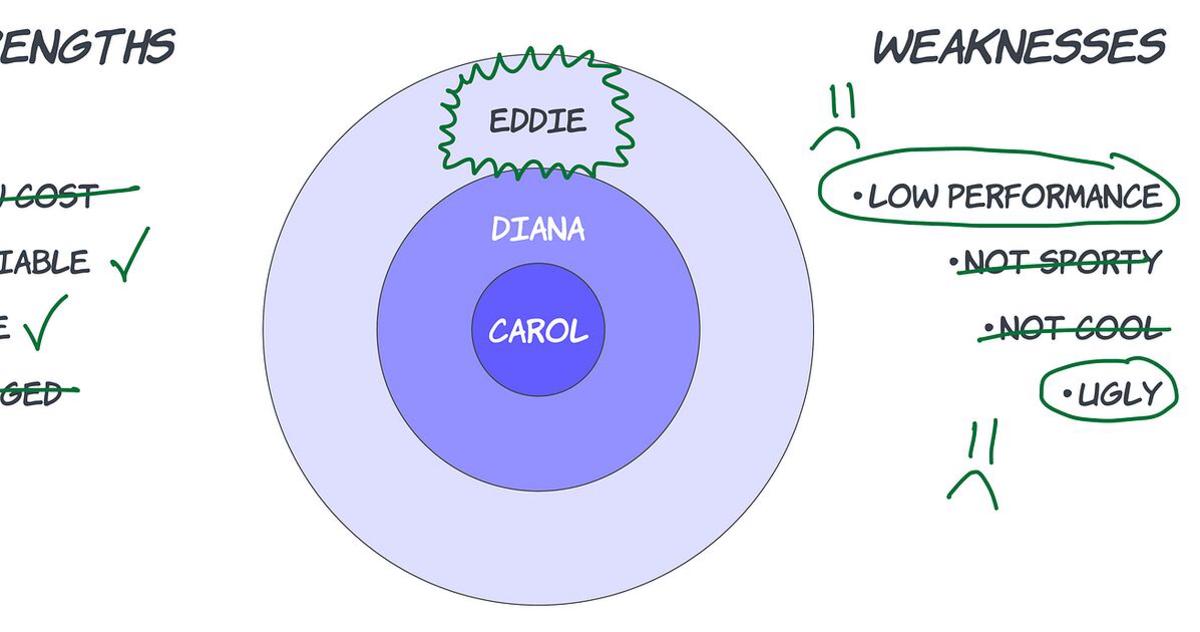
Six skills, run in sequence, that turn an honest look at who you are into a precise definition of your ideal customer — the one whose love transforms your marketing, sales, pricing, and product. Adapted from Selling to Carol: Why targeting an ICP brings 10x more customers than you expected.
What this is about
A small fraction of your customers make most of your profit. At WP Engine, 5% of customers produced 40% of the profit. The book calls the composite of these perfect customers Carol. The book makes a claim that seems wrong at first, and gives two chapters of proof for it: if you aim all your marketing, positioning, and product development at Carol alone, your market does not shrink. You win the ring of buyers who share her trade-offs — a ring ten times larger. You also win the ring of buyers who weigh those trade-offs and pick you anyway — a ring one hundred times larger. In 1994, Subaru targeted lesbians. Subaru then became the fastest-growing car company of the next decade. Most of Subaru's new buyers were not gay. Clear trade-offs, stated with confidence, win everyone who leans your way.
You cannot invent Carol from wishes. You derive her, step by step, from an honest look at who you actually are. Start with your real strengths and real weaknesses. Refine these into the keystones that force a purchase, the deal-breakers that block one, and the inciting events that turn a someday-buyer into a today-buyer. This workshop comes from Carol Loves You for You and Speaking Carol Into Existence, Chapters 2 and 3 of Hidden Multipliers. It runs this process as six skills. Each skill produces a file. The next skill uses that file. This way the work builds up. It does not disappear after a whiteboard session.
How to run it
- Get the raw facts on the record.
Observations walks you through twelve
tough question categories. Or it processes your team's write-storm
notes. The categories cover what customers praise, what makes them
leave, what you claim but are not, and what you envy. The output is
OBSERVATIONS.md: vivid, specific raw material, with no judgment yet. - Distill and classify.
Strengths & Weaknesses converts the
observations into the deep-truth attributes behind them. It removes
generic attributes with the Opposite Test. It classifies each attribute
as a strength, a weakness, or both —
STRENGTHS-WEAKNESSES.md. - Refine strengths into keystones.
Keystones asks one question for each
strength: whose circumstances require an extreme version of this
strength? A strength that names no real market segment is table stakes,
not a keystone. The output is
KEYSTONES.md. - Refine weaknesses into deal-breakers.
Deal-Breakers maps who is
disqualified, no matter how much they like you. This group is your
anti-market. The skill uses these exclusions to sharpen the description
of each keystone market. The output is
DEALBREAKERS.md, plus an improvedKEYSTONES.md. - Find the inciting events.
Inciting Events finds what moves a
perfect-fit customer from "priority seven" to "buying today." When you
have customer interviews, the skill pulls these events from them. When
you do not, it works backward from the keystones. The output is
INCITING-EVENTS.md. - Define Carol.
Define Carol combines everything into
CAROL.md. This file gives a clear, behavioral definition of your ideal customer. It lists her attributes first, because that is the point. It also includes reference sections on keystones, deal-breakers, and inciting events. Positioning, marketing, and product work all start from this file.
The output feeds every step downstream. Positioning speaks Carol's language. Marketing buys her attention. Sales qualifies leads against her markers. Product builds what thrills her. If you want to test what you have written, use the Customer Interviews workshop as a companion. Its first goal question is "What does Carol look like?" Its findings report feeds directly back into these files.
The steps
This workshop runs several skills in sequence, and some rely on others
(like asb-rude-qa) — install the whole set before you
begin: run npx skills add asmartbear/asb-skills, or
↓ download all skills as one ZIP.
More install options →
-
Observations
Extracts the unvarnished facts about your company.
Your company or product — plus your team's write-storm notes, if you ran one, or just yourself and an honest hour. An OBSERVATIONS.md of numbered, vivid, specific observations (O1, O2, …) organized by the twelve question categories — deliberately unevaluated.
asb-carol-observations -
Strengths & Weaknesses
Turns raw observations into classified attributes.
Your OBSERVATIONS.md of raw facts (O1, O2, …) — or a pile of observations you're ready to distill. A STRENGTHS-WEAKNESSES.md: distilled attributes classified as strengths (S1, S2, …) and weaknesses (W1, W2, …), each citing the observations behind it.
asb-carol-strengths -
Keystones
Finds the customers your strengths compel.
Your STRENGTHS-WEAKNESSES.md (S1, S2, …) from the classification step — or a strengths list you can defend. A KEYSTONES.md: keystones (K1, K2, …) mapped to strengths, each with the real-world market segments that typify it — or the honest finding that your product isn't compelling yet.
asb-carol-keystones -
Deal-Breakers
Maps your anti-market and sharpens your targets.
Your STRENGTHS-WEAKNESSES.md (the W-side) and your KEYSTONES.md from the previous steps. A DEALBREAKERS.md (D1, D2, … with anti-market segments) — plus your KEYSTONES.md honed: each segment description sharpened with the qualifiers the deal-breakers force.
asb-carol-dealbreakers -
Inciting Events
Finds the moments that trigger the purchase.
Your honed KEYSTONES.md — plus customer-interview findings, if you have them. An INCITING-EVENTS.md: trigger events (E1, E2, …) coupled to keystones, each marked observed or hypothesized, with notes on how to find prospects in that condition.
asb-carol-inciting-events -
Define Carol
Synthesizes everything into your Carol.
Your four working files: STRENGTHS-WEAKNESSES.md, honed KEYSTONES.md, DEALBREAKERS.md, and INCITING-EVENTS.md. A CAROL.md: the definition first — behavioral and attitudinal markers, not demographics — with reference sections on keystones, deal-breakers, and inciting events for the positioning, marketing, and product work that starts from it.
asb-carol-define