Excuse me, is there a problem? Score your idea's path to a viable business
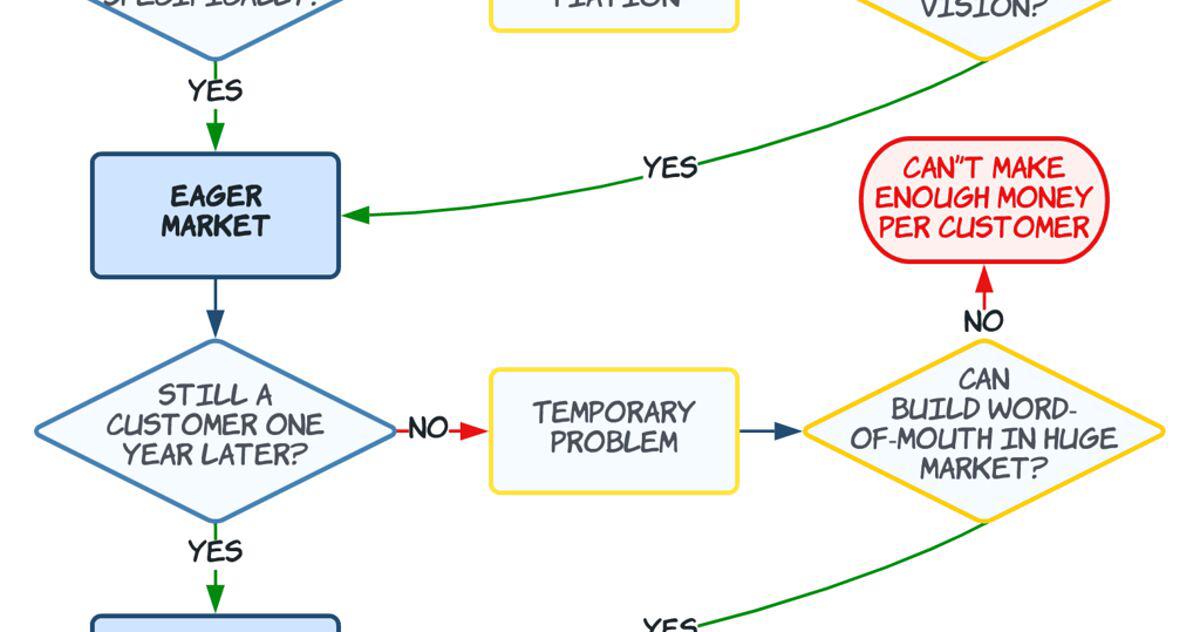
Find out whether your idea can become a real business — a seven-factor Fermi scorecard that multiplies out to a viability verdict before you build. Adapted from Excuse me, is there a problem?.
- Input
- A business idea — anywhere from a rough direction to a running product — plus whatever real data you have.
- Output
- A PROBLEM-SCORE.md scorecard — seven evidence-cited Fermi scores, a viability verdict, and re-scored niche scenarios.
What this is about
Solving a real problem is not enough to build a successful company. This may surprise you. Founders often confirm that the problem is real. They build a product that solves it. Many still fail. Five more gates stand between "a real problem" and "a viable business model." Founders also score themselves too high at each gate.
This skill guides you through the path from "The Problem" to "Viable Business Model." It scores your specific target market on seven multiplying criteria, using power-of-ten Fermi estimates. In the best case, all seven criteria hold. In reality, some are strong and some are weak. The multiplied score is a simple directional tool. It shows whether your big strengths overcome your few weaknesses. The skill will not score a generic idea. It challenges every optimistic number unless evidence backs it. It can do light research to check your market-size claims. When the score is negative, the skill helps you target a narrower niche and score again. Or it helps you face the truth that the idea is not viable — while you still have the time and money to find a better one.
The seven criteria
Each criterion has its own full story in a separate article. The score here is the short version.
- Plausible — Do 10M consumers or 100k businesses have the problem? The threshold comes from conversion math. It also comes from how price and quantity trade off in your business model.
- Self-Aware — Do they know they have the problem, and do they care? Customer development helps you find out. A mission helps you survive the work of teaching a market that does not know or care yet.
- Lucrative — Is there a large budget already set aside for this? Positioning your product as creating value rather than saving money often makes the difference.
- Liquid — Are they willing and able to buy right now? The failure mode is Product Purgatory: they love the product and agree it has value, but they still do not buy. You are only their seventh priority.
- Eager (identity) — Do they trust you, and do they want to buy from you specifically? The Love and Utility kinds of willingness-to-pay explain the mechanics.
- Eager (comparative) — Are you different in a way that enough of the market cares about? See leverage and Worse, but unique.
- Enduring — Will they still pay you, or recommend you, a year from now? Churn grows exponentially, while growth is at best quadratic. So retention math always catches up with you.
Example invocation
You can invoke the skill like this:
/asb-problem I'm building an uptime-monitoring tool for developers
of Shopify apps. It catches silent failures and alerts them before their
merchants notice. I'd charge $19/mo. I have 40 free beta users but only 3
paying customers so far. Score it — keep the files in ./viability
First, the skill holds you to a specific target market: a specific buyer, with a specific problem, at a specific price. Then it walks you through the seven criteria one at a time. It challenges every optimistic score unless evidence backs it. You end up with a scorecard file and a directional verdict. If the number is bad, you also get re-scored niche scenarios that might save the idea. Or you get a clear reason to move on.
Say where you are working. Name a directory, or point to existing files, in the invocation. This keeps the skill's files together in one place. If you do not say, the skill asks before it creates anything.
From the source
The main article behind this skill is Excuse me, is there a problem?. In it, Jason describes the full path from "The Problem" to "Viable Business Model": the seven scoring criteria, the Fermi-estimation rubric, the multiply-and-normalize scoring method, and what to do with a negative answer.
Each supporting article explains one criterion, or explains the scoring method itself:
- Fermi ROI: Fixing the ROI rubric — Explains why every score is a power of ten. Explains why you multiply the scores when every factor is required. Explains why you should debate only the scores where people disagree by a factor of ten.
- Product Purgatory: When they love it but still don't buy — The full story behind the Liquid criterion. Covers the Magic Wand Test, the top-three-priorities rule, and how to narrow your target with "…and needs it right now."
- Willingness-to-pay: Creating permanent competitive advantage for the right reasons — Explains Love, Utility, and Coercion: the mechanisms behind the Eager scores, and the lock-in part of the Enduring score.
- The three kinds of leverage that anchor effective strategies — Explains what real competitive differentiation is. This grounds the Eager (comparative) score.
- Worse, but unique — Explains that differentiation means you pick your own game. It does not mean you win the feature-comparison matrix.
- Pricing determines your business model — Explains what each order-of-magnitude change in price means for the business. This grounds the Lucrative score and the customers-needed math behind the Plausible score.
- Selling to Carol — Explains why targeting a narrower niche after a negative score does not shrink your ambition. Bullseye targeting sells far beyond the bullseye.
- Failure to face the truth — The posture behind the whole exercise: optimism inflation is the default. The score only helps if you refuse to flinch at the answer.
- Chapters 2 and 3 of Hidden Multipliers: Carol Loves You for You and Speaking Carol Into Existence — hiddenmultipliers.com — Explains why narrowing the target market to improve the score is usually the right move. Focus wins. The bullseye sells far beyond the bullseye.
- Chapter 4 of Hidden Multipliers: A Rose by Any Other Name (section "The Golden Rule of Copywriting: Be Specific") — hiddenmultipliers.com — Explains the specificity standard. The skill holds every target-market description to this standard before it will score anything.